
Demand
Raise and approve the requisition.
Auvora VMS · Aarohii AI Solution
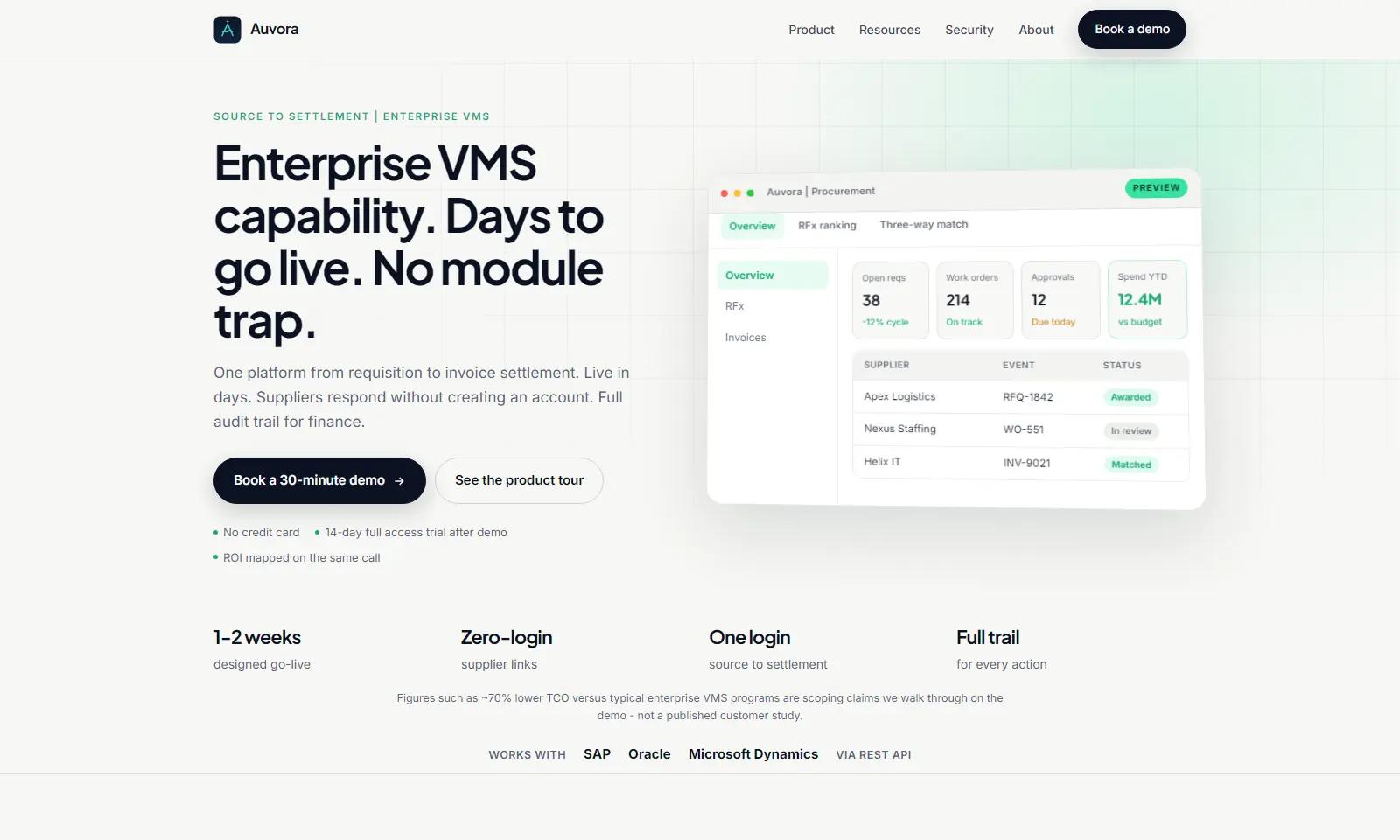
Procurement on Auvora is the buy cycle on one record: demand, RFx, purchase orders, SOWs, timesheets, and invoices. It sits inside Aarohii’s vendor management system—not a separate spreadsheet stack.
Buying still jumps between inbox, vendor portals, and finance. The requisition is approved in one tool. The quote lives in email. The SOW is a PDF. Time is logged somewhere else. The invoice arrives with no match. Settlement becomes a reconstruction project.
Auvora is built so procurement, recruiting, and supplier-ops share the same engagement from the first request through settlement.
Raise and approve the requisition.
Invite vendors. Collect quotes or candidates.
Issue the PO, SOW, or work order.
Match invoices to time and commercial terms.
Related: Auvora product overview · What a VMS is · Signs your procurement process has outgrown spreadsheets · Demo requests auvora.co.in
Almost every reconciliation problem traces to the same root: the commercial terms, the delivered work, and the invoice were recorded in three systems by three people, and nothing forces them to agree. The invoice arrives, finance asks what was agreed, procurement forwards an email, and the supplier waits.
The check that resolves it is unglamorous — does the invoice match the order, and does it match what was actually delivered? When requisition, award, and timesheet are the same record, that check is automatic. When they are not, it is a person rebuilding a story from attachments, which is why invoice queries take days rather than minutes.
Clean buys need almost no software. The cost lives in the awkward cases: a rate changed mid-engagement, an extension nobody raised a new order for, a partial delivery, an invoice for work split across two cost centres. A procurement tool is worth its licence only if those cases are visible as exceptions rather than discovered at month end.
So when evaluating one — ours included — ask to see the exception, not the happy path. Raise a requisition, award it, then change something, and watch whether the system shows the mismatch or silently accepts it.
None of these is a software question, and all four determine whether the rollout works. A tool configured around undecided rules just moves the argument into a new interface.
It is not an ERP, not a general ledger, and not a spend-analytics product bolted onto exported data. It is the buy cycle held on one record, inside the vendor management system, so settlement has something to settle against. Accounting stays where it belongs.
Yes. Procurement is a core loop on Auvora, Aarohii’s VMS. Open auvora.co.in to verify.
No. Auvora is a vendor management system for the source-to-settle cycle. It is not a general ledger.
On the live product. We do not duplicate a stale price table here.
Yes — that is the point of running procurement inside a VMS. Timesheets and work orders sit on the same engagement as the purchase order.
No. Auvora settles against commercial terms and delivered work; your ledger stays where it is.
Write down approval thresholds and what a payable invoice must reference. Those two decisions remove most reconciliation work on their own.
If buying still lives in email and sheets, walk the live VMS or request a 20-minute fit call.
Open Auvora Request a fit call