
Requisitions
Open demand, route approval, and keep status visible from opening to offer.
Auvora · a product of Aarohii
A VMS is the system of record for vendors and contingent work—from the first requisition to the last invoice. Aarohii’s VMS is Auvora, available by demo at auvora.co.in.
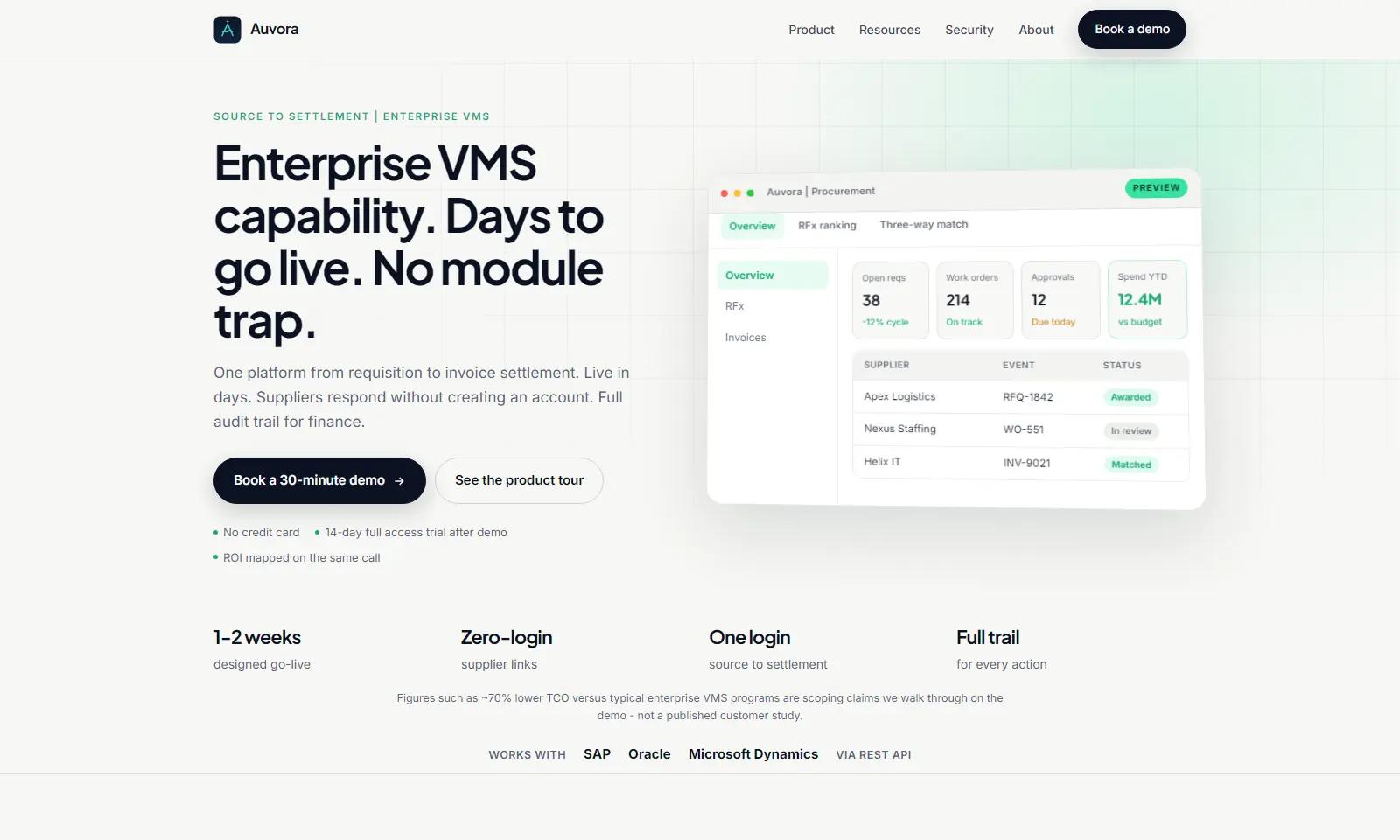
Teams that hire through suppliers or buy through vendors usually scatter the work: a requisition in email, candidates in a spreadsheet, the SOW in a shared drive, timesheets in a portal, and the invoice in finance. A vendor management system keeps that cycle on one record.
It is not a CRM. CRM tracks customers and deals. A VMS tracks suppliers, requisitions, work orders, and settlement. Aarohii’s CRM and sales product is Captverse. The VMS is Auvora.
Open demand, route approval, and keep status visible from opening to offer.
Invite vendors, collect submissions, and compare without assembling a side sheet.
Quote, award, and place the PO against the same engagement.
Commercial terms stay attached to the work—not in a mailbox.
Time is captured against the live work order so delivery and billing match.
Close billing against the SOW and time captured, with an audit trail.
| Need | Use | Aarohii product |
|---|---|---|
| Customers, pipeline, inventory, payments | CRM / business OS | Captverse |
| Vendors, contingent labour, SOWs, timesheets | VMS | Auvora |
| RFx, POs, supplier spend, settlement | Procurement on the VMS | Procurement |
Read more: VMS vs CRM · What is a VMS? · VMS implementation: days vs months
The trigger is rarely vendor count. It is the number of hand-offs. One person placing four contractors a year does not need a system; a spreadsheet and a folder are honest tools at that scale. The cost appears when three or more people touch the same engagement and each keeps their own version of its status.
Concrete signs the process has outgrown the spreadsheet stack: nobody can say what a supplier has cost this quarter without rebuilding it from invoices; approvals are reconstructed from email threads when someone asks who agreed to a rate; a contractor's end date lives only in a calendar entry belonging to whoever hired them. Longer list: signs your procurement process has outgrown spreadsheets.
If none of those is true, we will say so. A system nobody needed is worse than the spreadsheet it replaced, because it adds a login to a process that was already working.
Every item in the grid above exists elsewhere as a standalone tool. What a VMS adds is that the requisition, the award, the work order, the timesheet, and the invoice are the same record at different stages — so matching an invoice is a lookup rather than an investigation.
That is also the test to apply to any VMS demo, including ours: ask to raise a requisition, award it, log time against it, and settle the invoice in one sitting. If the demo changes systems or asks you to imagine a step, the record is not actually joined.
Most of the work is not software configuration. It is deciding whose approval is required at which threshold, agreeing a supplier list that someone will maintain, and settling what happens to work already in flight when the system goes live. Teams that decide those three things quickly go live quickly; the timeline argument is covered in VMS implementation: days vs months.
The predictable friction is data. Existing supplier records are usually duplicated, and contractor records usually disagree with payroll. Neither is a reason to delay, but both are a reason not to promise a clean migration on day one.
You can run all five in a live Auvora demo rather than against a sales deck: auvora.co.in.
It is not a CRM, and the distinction is not pedantry: customer pipeline and supplier engagement have different records, different approvals, and different audit needs. Ours live in different products — CRM in Captverse, vendors in Auvora. It is also not an ERP and not a general ledger; it settles against commercial terms and hands the accounting to the system that owns it.
Software for the vendor and contingent-workforce cycle: requisitions, suppliers, candidates, work orders, SOWs, timesheets, and invoices from sourcing to settlement.
Auvora, designed, built, and operated by Aarohii AI Solution Private Limited. Request a demo at auvora.co.in.
No. CRM lives in Captverse. Auvora is the VMS.
Hand-offs matter more than vendor count. When three or more people touch the same engagement and each tracks its status separately, the reconciliation cost is already being paid somewhere.
No. Auvora covers the source-to-settle cycle and hands accounting to the system that owns your ledger.
It is decided before launch, not during. Usually open engagements are entered at their current stage and closed ones stay in the old records.
If vendor work still lives in email and spreadsheets, open the live VMS or book a 20-minute fit call.
Open Auvora Auvora overview Request a fit call